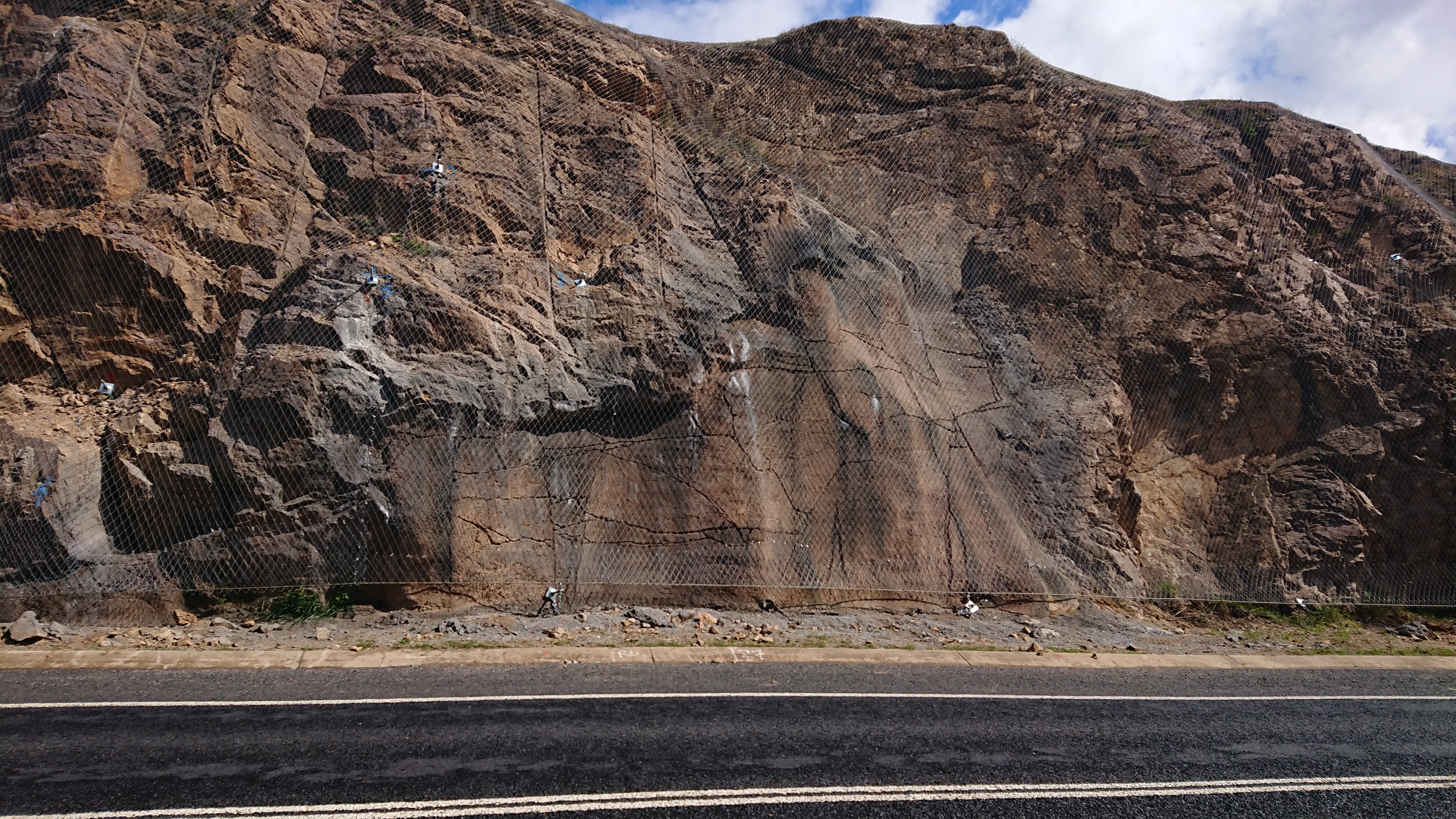
Management of landslide repairs to Wolgan Valley Road has been a disaster. The road was closed in November 2022 and remains closed after three years of the sort of bureaucratic bungling made famous in the satire Utopia. It’s been a feeding frenzy for consultants with over $13.5 milion spent to get back to square one. I was asked to give a brief outline of some of the issues at recent community meeting and this is now available on youtube.

.

Posted by: Marc Hendrickx | March 20, 2025

Alpine Way SRA

Just completed 115 slope assessments on the Alpine Way in southern NSW, with Matt Kilham. The package included mostly ARL3-5 slopes. The ARL5 slopes were first assessed when the wider slope assessment program commenced in 2005.

Many changes along the Alpine Way in that time including wide use of rock fall mesh to control rock falls from cuttings along the narrow road. Many corrugated steel culverts were found to be in less than satisfactory condition and some of these have resulted in changes to earlier ratings.

All in all an enjoyable 2 weeks in the bush. We stayed at Waratah House in Khancoban (see AirBNB).

Posted by: Marc Hendrickx | September 25, 2024

Hornsby By-election

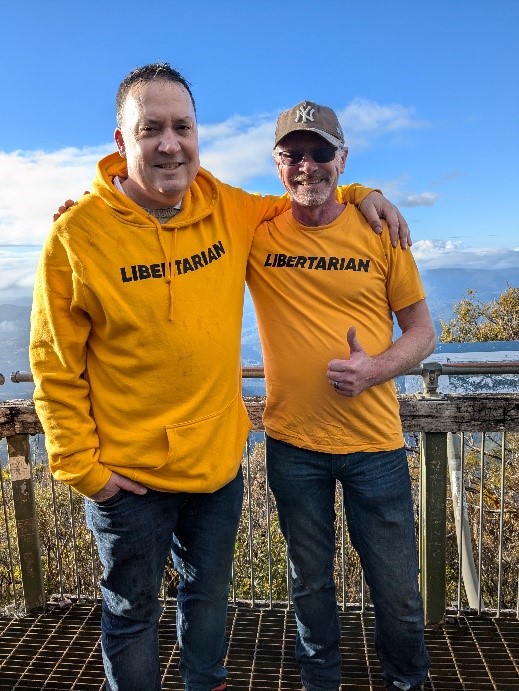
I’m running as the Libertarian Party Candidate in the up coming Hornsby by-election on 19th of October.

LIBERTARIAN PARTY CANDIDATE FOR HORNSBY BY-ELECTION

The Hon John Ruddick MLC announces Geologist and author Marc Hendrickx will represent the party at the Hornsby by-election.

Marc has run an independent geological consultancy for the last 12 years (specialising in Landslide Risk Analysis) and is a long term member of the local RFS brigade. Marc and his family have lived in the Hornsby area for over 20 years.

Marc is a keen outdoors enthusiast and has been at the forefront in battling foolish, irrational government decisions which ban the public from our National Parks. He has written books on why Uluru/Ayers Rock and Mt Warning should be open to all.  If these battles are not won then access to the pristine National Parks in Hornsby will come under threat.

Marc’s focus will be on putting local issues to the forefront and achieving positive outcomes for an electorate that has long been ignored by the major parties.

  • Slash red and green tape and state taxes to open up business opportunities in the electorate.
  • Let’s ensure our wild places are well maintained and remain open for all Australians
  • Ensure State Government focuses on the important stuff: Transport, Education, Health, and affordable reliable electricity and stays away from woke politics and agendas.
  • Poor planning has seen population growth along major corridors in the electorate being done without supporting infrastructure like roads, schools and recreational places.  Let’s get a new high school to service the growing local population and not have our children travel for hours to get to school each day.
  • Develop a 30 year plan for sustainable growth for the electorate.
  • Sub-standard transport routes. Let’s fix the problem areas like Galston Gorge and traffic jams along New Line Road for good.  What about a full interchange on the M1 at Mt Colah?
  • Increased autonomy for local RFS Brigades to better manage bush fire risk their local areas.

For NSW

  • Reduce state taxes and duties and free up more of your money to spend on things you need, rather than have government bureaucrats waste it through bad decisions, poor planning and poor management.
  • Slash red, green and brown tape to open up business and employment opportunities in Hornsby and the rest of NSW.
  • Ensure our beautiful wild spaces, our National Parks and State Forests are well maintained and remain open for all Australians.
  • Keep the government as small as it needs to be and focused on practical State issues and out of our day to day lives and away from woke causes.
  • Slash the back room bureaucracy who add no value to our state but cost us $billions. Redirect these funds to front line services, paying off our huge State debt and providing tax relief.
  • Provide the regulatory environment for investment in cheap reliable sources of energy.
  • We will put you in charge of your own health – we reject the over-reaction of the mandatory Covid measures that did great harm to our State, especially our youth.
  • Modify the NSW Land Rights Act 1983 to ensure Crown land remains in public hands and remains accessible to all.
  • Ensure National Parks stay in public hands and access is available to all Australians.
  • Remove recreational fishing licenses, you don’t need a nod from big brother for your family to cast a line.
  • Maintain our freedom of speech and thought by stripping fees to access government information and opposing legislation that cuts our right to speak.
Posted by: Marc Hendrickx | August 11, 2024

Bolt Report 5 August 2024

Interview with Andrew Bolt on the Bolt report 5 August 2024, about the on going closure of an iconic NSW bushwalking experience – the Mt Warning Summit Track. How long can this nonsense go on for?

Posted by: Marc Hendrickx | September 25, 2023

A guide to climbing Mount Warning

My new book A Guide to Climbing Mount Warning: the fight for awe and wonder, is now available to order from Connor Court – just follow the link…

https://www.connorcourtpublishing.com.au/A-GUIDE-TO-CLIMBING-MOUNT-WARNING–Marc-Hendrickx_p_564.html

ISBN: 9781922815804

October 2023 release

Mount Warning National Park provides one of the most outstanding experiences of the Australian Landscape on the east coast. Mount Warning was an immense shield volcano active 23 million years ago, and is now regarded as the best preserved and largest eroded shield volcano in the southern hemisphere. The original volcano was over 100km in diameter and likely reached over 2000m high. The 1159m peak of Mount Warning is the solidified remains of the main central vent of the volcano. 360 degree views from the summit to the Pacific Ocean beaches, the Tweed River valley and the surrounding forested ranges forming the caldera walls are simply extraordinary. Since a 4km track was constructed in 1909 over 3.5 million people – families, friends and individuals have made the journey to the summit to experience the exhilaration of the climb, the awe inspiring vista and for some, the joy of witnessing the first sunrise on the Australian Mainland.

More recently public access to the Park and Summit have become contentious as post-modernist political concepts have captured the minds of Park Authorities trusted with managing the Park on behalf of the Public. There has been a push to close the Park on the grounds public access offends some Aboriginal groups. Other Aboriginal groups challenge this belief, including those that have the closest connection to the mountain – the Ngarakwal People. The matriarch of this group, the late Marlene Boyd stated in 2007 “I do not oppose the public climbing of Mount Warning – how can the public experience the spiritual significance of this land if they do not climb the summit and witness creation!” This wonderful endorsement of what we all feel when we visit these remarkable natural places has been long ignored by the authorities.

A Guide to Climbing Mount Warning is a celebration of the Park and summit experience. The Guide is packed with historical information, facts and figures that demonstrate official views about the mountain in relation to environmental damage, safety and Aboriginal perspectives are fundamentally wrong. Moves to close the Park are more about politics and misconceptions about risk management. This flawed approach will result in a National Park that will have no visitors. Awe and wonder to be hidden behind a locked gate. This would be an insult to the millions who have climbed and those who worked so hard to create the Park in 1929 preserving this wonderful place and the adventure it holds for future generations to explore and enjoy.

Posted by: Marc Hendrickx | April 10, 2022

Boulder removal 22 March

Keen-eyed T4NSW maintenance supervisor Terry reported this very large rock on the Old Pacific Highway near Calga for engineering assessment. It had moved about a meter on clay softened during the recent rain events. The road was closed as there was not much holding it on and preparations made to remove it the following day. T4NSW provided a protective blanket on the pavement. Fortunately, Rik and Jarrod from SSS (specialist site services) were available with a compressor and some high-strength jacking pads.

While I thought it may have taken more than one lift to shift it, it went on the first attempt. We took a few more smaller ones off to tidy up.

Road was cleared and reopened later in the day. Thanks to T4 NSW and SSS!

Posted by: Marc Hendrickx | September 3, 2020

Castlereagh Highway slope remedial works

Completed mesh and shotcrete works along Castlereagh Highway south of Mudgee.

Another high-risk slope dealt with!

Posted by: Marc Hendrickx | April 30, 2020

Coromandel Peninsula

Took this footage of a medium landslide on the Coromandel Peninsula in February. Hoping to get back there later in the year to run some training courses.

Posted by: Marc Hendrickx | August 15, 2019

Fibrous Tremolite in Central New South Wales

Selected papers presented at the 61st AEG Annual Meeting/13th IAEG Congress in San Francisco, California on September 15-23, 2018 have been placed into a special edition of Environmental and Engineering Geoscience. Marc’s Paper on Tremolite occurrences in central NSW is now available online via the following link…

https://www.researchgate.net/publication/335093892_Fibrous_Tremolite_in_Central_New_South_Wales_Australia

Abstract

Tremolite schists in Ordovician meta-volcanic units in central New South Wales (NSW) consist of fine fibrous tremolite-actinolite. They host tremolite asbestos occurrences, and small quantities of asbestos were mined from narrow vein deposits in central NSW during the last century. When pulverized, the tremolite schist releases mineral fragments that fall into the classification range for countable mineral fibers and may be classed as asbestos despite not having an asbestiform habit. The ambiguity in classification of this type of natural material raises significant health and safety, legal, and environmental issues that require clarification. While the health effects of amphibole asbestos fibers are well known, the consequences of exposure to non-asbestiform, fibrous varieties is not well studied. This group of elongated mineral particles deserves more attention due to their widespread occurrence in metamorphic rocks in Australia. Toxicological studies are needed to assess the health risks associated with disturbance of these minerals during mining, civil construction, forestry, and farming practices.

DOI: 10.2113/EEG-2273

Posted by: Marc Hendrickx | October 19, 2018

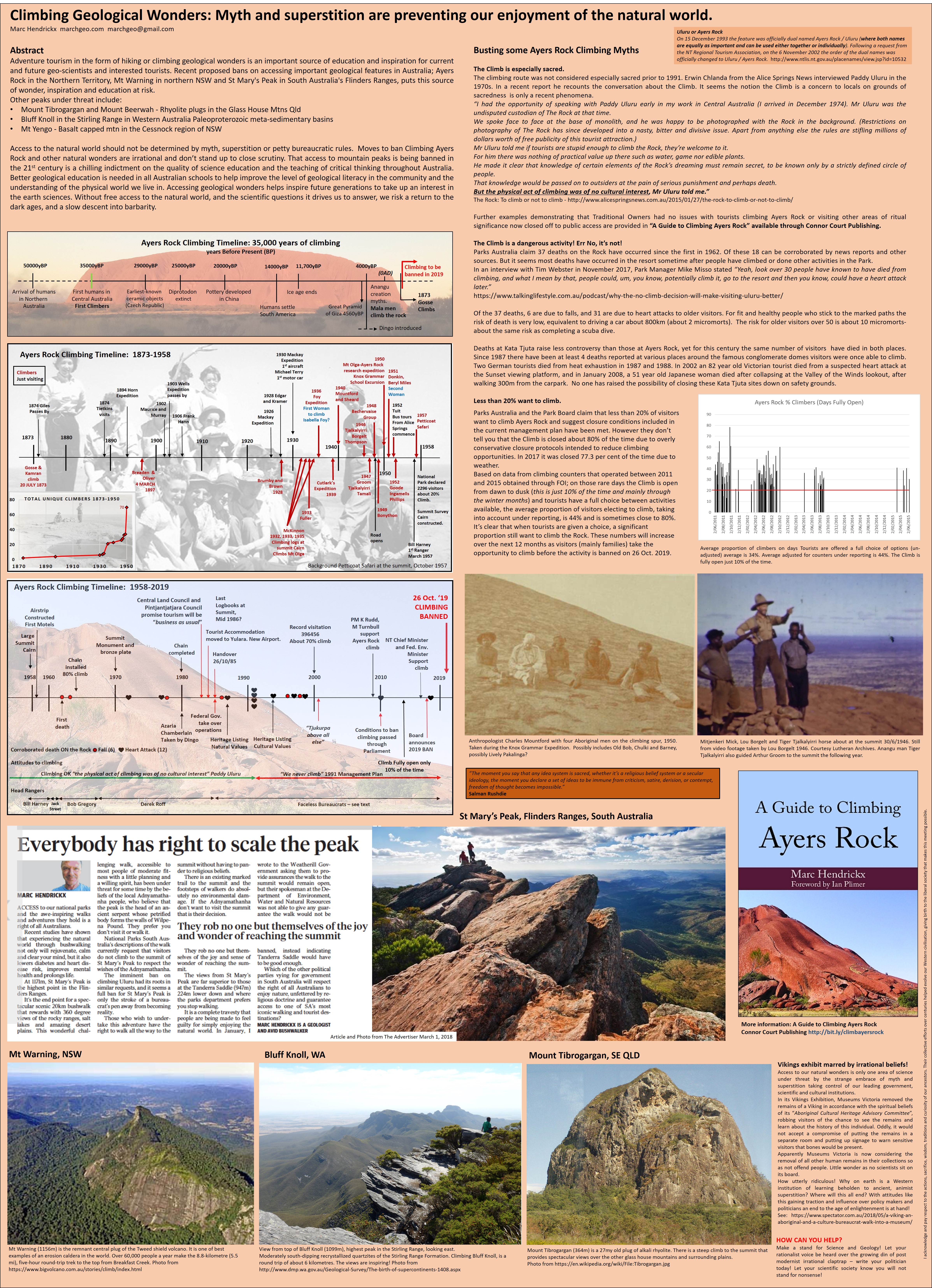
AGCC 2018: NOA and Climbing natural wonders

Marc attended the Australian Geoscience Council Convention (AGCC 2018) in Adelaide this week. He presented on ambiguous amphiboles and put up a poster on climbing natural wonders. Abstract for the NOA presentation and a copy of the poster appear below.

What should we do about naturally occurring fibrous amphiboles: do they pose the same health risk as asbestiform varieties? 
Asbestiform amphiboles are listed as a Group 1 carcinogens by the International Agency for Research on Cancer (IARC).  They include asbestiform varieties of riebeckite (crocidolite), cummingtonite‐grunerite (amosite), tremolite, actinolite, anthophyllite, winchite and richterite. It is likely that other asbestiform amphibole varieties have similar adverse health effects. Amphiboles have a wide range of mineral habits and may show variation from columnar, fibrous and asbestiform habits, sometimes in a single specimen.
Tremolite schists in Ordovician meta-volcanics in central NSW mainly comprise fibrous tremolite-actinolite. They are associated with tremolite asbestos occurrences, and small quantities of asbestos were mined from narrow vein deposits in this area last century. When pulverised the host tremolite schist releases mineral fragments that fall into the classification range for countable mineral fibres and may be classed as asbestos, despite not having an asbestiform habit. The ambiguity in classification of this type of natural material raises significant health and safety, legal and environmental issues that require clarification.
While the health effects of amphibole asbestos fibres are well known and procedures are in place to reduce the risks, the consequences of exposure to non-asbestiform, fibrous varieties is not well studied. This group of minerals deserve more attention due to their widespread occurrence in metamorphic rocks in Australia, and their potential disturbance through mining, civil construction, forestry and farming practises. Toxicological studies for instance would improve our understanding of the risk of exposure.

Climbing Geological Wonders: Myth and superstition are preventing our enjoyment of the natural world.


Older Posts »

Categories