Paper recently presented at the 2026 AGS Sydney Symposium. Download the full paper via the AGS website…
ABSTRACT
The triple La Nina of 2020-2022 severely impacted Eastern Australia. The prolonged period of above average and record rainfall caused multiple flood emergencies, saturated soils and triggered 1000’s of landslides across QLD and NSW, many with disastrous outcomes. This put immense pressure on under resourced government authorities to respond to landslide disasters. With necessary experience and resources hollowed out of the public sector, the challenges were mostly met by engaging the services of professional geotechnical consulting firms. Overall, the obstacles posed by these extreme weather events were arguably well managed with a large proportion of failures successfully remediated efficiently with cost effective solutions.
Use of rapid slope risk assessments under the umbrella of the RMS Guide to Slope Risk Analysis and application of ALARP risk management principles providing controlled access to public infrastructure while events were unfolding became a feature of the coordinated response. However, in a few cases the system was found wanting with poorly justified extended road closures that have had devastating economic impacts on local communities and disproportionate, highly costly repairs that did not apply scarce public funds in the most cost-effective manner.
This paper looks at two similar landslides in colluvial soils in the Sydney Basin that unfolded during 2022. While similar in their geological characteristics and risk attributes, these landslides had vastly different management outcomes: “Good” – Settlers Road, and “Bad and Ugly” – Wolgan Valley Road. These case studies provide lessons for management of landslide disasters in the future. Key lessons include the early application of sound engineering geological judgement to complete preliminary investigations developing geological models to rapidly understand landslide mechanisms allowing evidence based assessments of potential consequences to life and property; application of ALARP principals to provide options to asset owners to quickly restore temporary and short-term public access as a priority; and the need for technical expertise from asset owners to understand implications of risk assessments, provide high level reviews and take responsibility and step in to change course when things go wrong. The later requires restoration of engineering leadership, capability and systems in government agencies (state and local) responsible for managing our immense road networks.
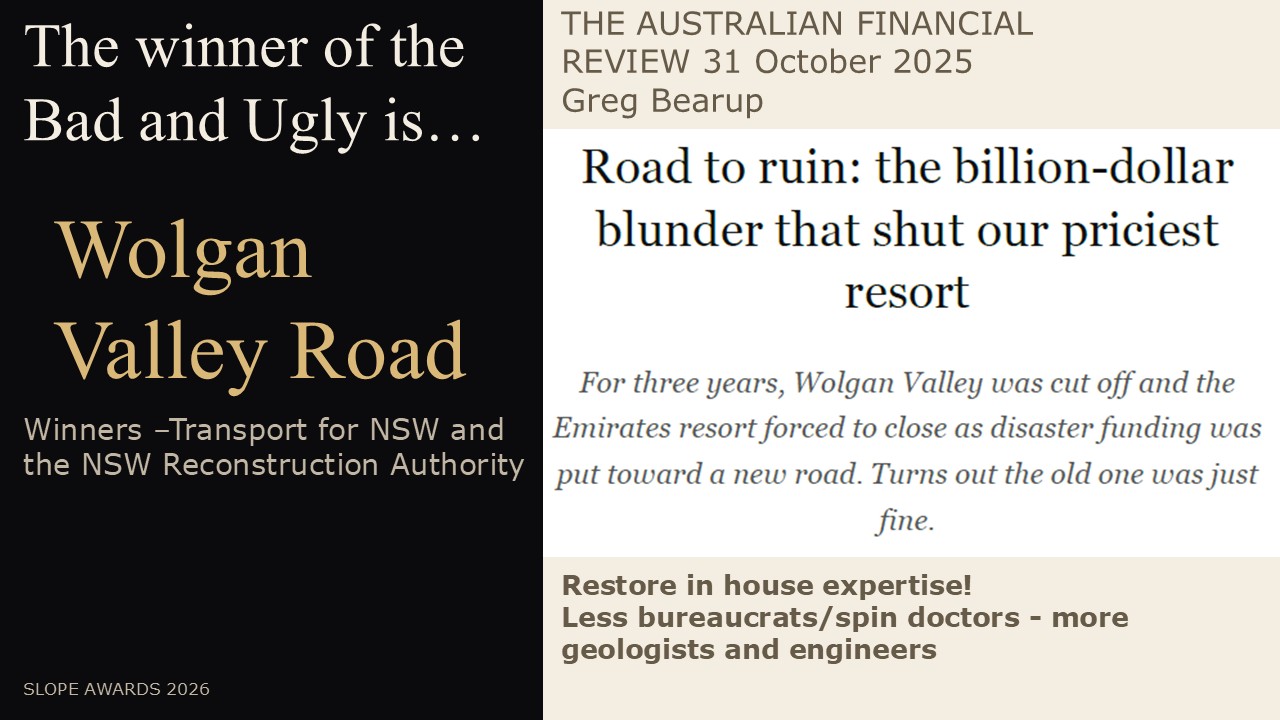
Screenshot from presentation – announcing the “Thumbs Down” Bad and Ugly Award for Worst Project Management of a Slope Remediation project during the triple La Nina period – Recipients… Transport for NSW and the NSW Reconstruction Authority.


Leave a Reply